Colorbond Downpipes: Sizes, Colours and What Suits Hobart Homes
Water running down the outside of your house is not just a cosmetic problem. In Hobart, where plenty of homes sit on sloping blocks with clay-heavy soil, a downpipe that overflows or discharges in the wrong spot can undermine footings, soak a subfloor and turn a garden bed into a bog.
Colorbond downpipes are the standard answer on Tasmanian homes, and for good reason. But the size, profile and colour matter more than most homeowners expect, and getting the number of downpipes wrong is a common fault. Victory Plumbing Hobart put this guide together so you can make the call before anything is ordered.
What a Colorbond downpipe actually is
A Colorbond downpipe is a pre-painted steel pipe that carries water from your gutter down to the stormwater system. The colour is not paint applied on site. It is a factory-baked five-layer coating built on the same system used for Colorbond roofing, including BlueScope's Activate corrosion-resistant technology.
The steel is made in Australia to AS 1397 and AS/NZS 2728, and BlueScope has been testing it in Australian conditions for more than 60 years. The unpainted alternative is Zincalume steel, which performs in a similar way but leaves you with a bare silver finish rather than a colour match.
Common Colorbond downpipe sizes and profiles
Downpipes come in two basic shapes. Rectangular and square profiles are the most common on Australian homes, in 100 x 50mm, 100 x 75mm and 100 x 100mm. Round downpipes are made in 75mm, 90mm and 100mm diameters.
Suppliers generally stock them in 1.8m and 2.4m lengths, cut and joined to suit the wall height. The 100 x 50mm rectangular profile and the 75mm or 90mm round profiles cover the majority of Hobart houses.
Size is not purely a style choice. The minimum downpipe size is tied to the gutter it drains. A standard high-front quad gutter, for example, needs at least a 90mm round or a 100 x 50mm rectangular downpipe to meet the requirements set out in AS/NZS 3500.3.
How many downpipes does a Hobart roof need?
This is where local numbers matter, and where most online guides fall short because they are written for the mainland.
Roof drainage in Australia is designed around a design rainfall intensity for your specific town. Lysaght's Victoria and Tasmania rainwater design tables put Hobart at 86mm per hour for a one-in-20-year event and 120mm per hour for a one-in-100-year event. Launceston sits at 91 and 123.
Compare that with Melbourne at 132 and 187, Burnie at 128 and 178, or St Marys on the east coast at 150 and 207. Hobart has a genuinely gentler design rainfall than most of the country.
That has a practical consequence. Each downpipe on a Hobart roof can serve a larger catchment area than the same downpipe in Burnie or Melbourne, so homes here tend to be fitted with fewer of them. It also means there is very little spare capacity when one blocks with leaf litter, or when a storm runs past the design event.
The number itself comes from a calculation, not a guess. Your plumber takes the total roof catchment area, works out how much area a single downpipe can serve given your gutter's cross-sectional area and the local rainfall intensity, divides one by the other and rounds up. Eaves gutters also need a fall of at least 1:500 towards those downpipes, with brackets no more than 1200mm apart.
If someone quotes a downpipe count without asking about your roof area or your gutter profile, ask how they arrived at it.
Matching the colour to your roof and gutters
Colorbond steel comes in 22 core colours, six of which are also offered in a premium Matt finish. Downpipes are available across the range, so you can match your gutter and fascia exactly or contrast them on purpose.
On most Hobart homes the safer approach is to match the downpipe to the gutter rather than the roof, because the downpipe reads as part of the wall line. Darker colours such as Monument, Woodland Grey and Basalt hide the streaking that develops on the face of a downpipe over time. Pale colours such as Surfmist and Classic Cream suit weatherboard cottages but show dirt sooner.
Order the downpipes, gutter and fittings together where you can. Colour and finish are easier to keep consistent across one order than across three.
How well do they hold up in Tasmanian conditions?
Well, as long as the system is maintained and the site suits it.
BlueScope's guidance is that surfaces washed by rain generally look after themselves, but unwashed areas need hosing down with clean, fresh water at least every six months, and more often in coastal areas where marine salt spray is present. The back of a downpipe sitting against a wall, and any length sheltered under an eave, falls squarely into that unwashed category.
That is directly relevant along the Derwent and around Bellerive, Sandy Bay, Kingston Beach and the channel. Lysaght specifically advise seeking product advice before using these products within one kilometre of marine, severe industrial or unusually corrosive environments. If your home sits close to open water, raise it with your plumber before ordering rather than after.
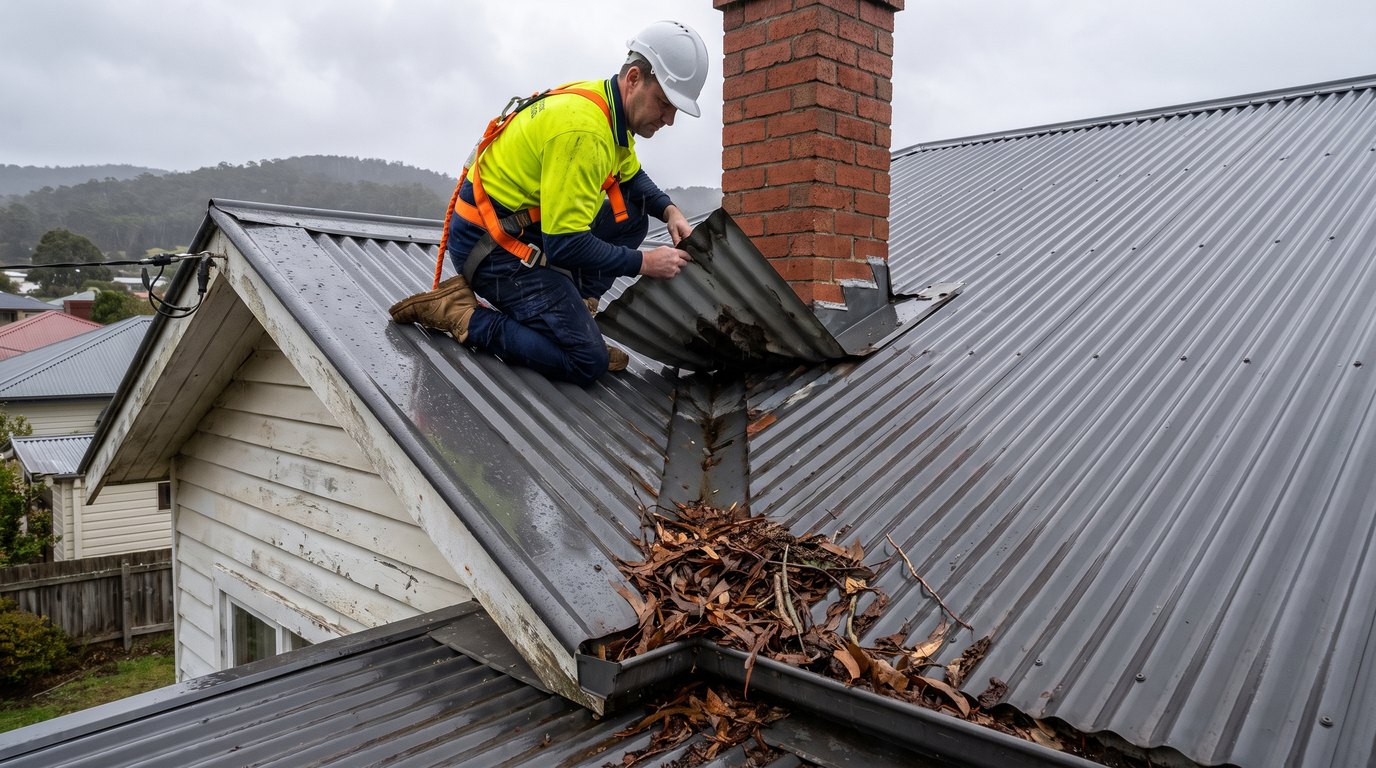
Warranties are available from BlueScope, but they have to be applied for and there are eligibility conditions attached. One of those conditions catches people out. Allowing debris to build up in gutters and downpipes can void the warranty, so regular cleaning is not optional, and how often you should clean your gutters in Tasmania depends largely on how many trees sit above your roofline.
The fittings that make the system work
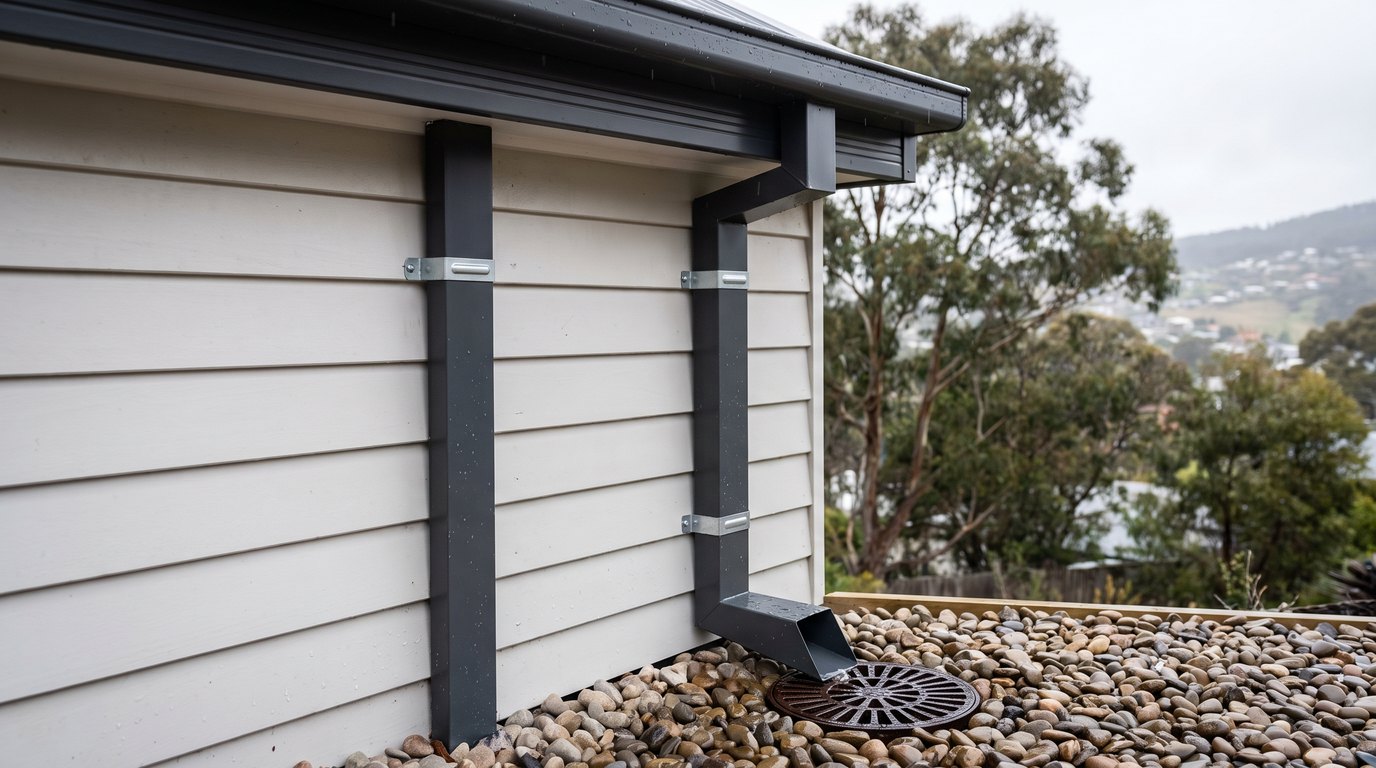
A downpipe is only as good as the parts joining it up. The main ones are pops or nozzles at the gutter outlet, offsets and bends to carry the pipe back under the eave and against the wall, astragals or brackets to fix it, and a shoe at the base to direct water away from the footings.
Offsets are the fitting worth thinking about early. A modern home with deep eaves needs a long adjustable offset, while an older Hobart cottage where the gutter sits almost flush against the wall needs a much shallower one. Using the wrong offset leaves the pipe strained at its joints, and joints are where leaks start.
Mistakes we see on Hobart homes
The most damaging is metal incompatibility. Lead, copper, bare steel and some chemically treated timbers should not contact Colorbond steel, and rainwater should not discharge from them onto it. That is a real risk on older inner-Hobart homes with original copper or lead flashings, where a new steel downpipe placed downstream will corrode long before it should.
The second is discharge at ground level. A downpipe that finishes in a shoe pointed at a garden bed, rather than a connected stormwater point, simply moves the problem to your footings.
The third is treating downpipes as a separate item. Gutter capacity, overflow provisions, downpipe count and the stormwater connection work as one system, which is the argument for understanding how gutters and downpipes protect your home before you change any single part of it.
Getting it installed properly
Roof drainage is regulated work. It has to satisfy the National Construction Code, most commonly by complying with AS/NZS 3500.3, and installers are generally required to hold the appropriate licence for the work.
Beyond compliance, the detail is what lasts. Joints sealed with a neutral-cure silicone rated for Colorbond steel, swarf swept out of gutters and downpipes at the end of each day so it cannot rust into the finish, and every fitting matched to the profile it joins.
If you are replacing downpipes, adding capacity or trying to sort out an overflow problem, our roof plumbing team in Hobart can look at the whole drainage system rather than swapping like for like. Give us a call and we will assess it before anything is ordered.