Bathroom Renovation Contractor Near Me: A Hobart Homeowner's Checklist
Search for a bathroom renovation contractor near you and you get a wall of tiled galleries, five star ratings and free quote buttons. What none of that tells you is the part that decides whether your bathroom still performs in ten years: who is licensed to do the plumbing, whether the waterproofing is done to standard, and what paperwork you should be holding at the end.
Victory Plumbing Hobart works on bathrooms across Greater Hobart, and the jobs we get called back to look at are rarely about tile choice. They are almost always about water going somewhere it should not, because the plumbing and the waterproofing were treated as a detail rather than the foundation of the job.
Here is what to check before you accept a quote.
Start with the licence, not the gallery
"Bathroom renovator" is not itself a licensed occupation in Tasmania. A bathroom renovation is a bundle of trades, some of which are licensed and some of which are not. So the useful question is not "are you licensed", it is "who is doing the plumbing on my job, and are they licensed to contract for it".
In Tasmania you need a plumbing contractor's licence to enter into a contract to perform plumbing work. That licence also carries an insurance obligation. The cover must include personal injury and property damage of at least $5 million for any one occurrence.
Consumer, Building and Occupational Services, usually shortened to CBOS, publishes a public register you can search yourself. Look up "Find a licensed tradesperson" on the CBOS website, search the business or the individual, and check the result matches the name on your quote. It takes two minutes and it is the single most useful thing you can do before signing.
Ask for the certificate of currency for public liability as well. A licensed contractor will have it ready.
What a bathroom renovation actually counts as here
CBOS sorts plumbing work into three risk categories, and knowing which one your job sits in tells you what should be happening behind the scenes.
Low risk work covers changing fixtures and fittings and straightforward repairs. No permit or approval is needed. Medium risk work, called notifiable work, covers the majority of work undertaken in existing buildings, and CBOS names installing new fixtures in bathrooms and kitchen renovations as examples. High risk permit work covers things like on site wastewater management systems and backflow prevention devices.
Most Hobart bathroom renovations sit in that middle category. Notifiable plumbing work means a Notice of Work is lodged with the permit authority, which for most homeowners is the council, and a Certificate of Likely Compliance is obtained.
If a contractor tells you a full bathroom renovation involves no notification at all, that is worth a second conversation before you go further.
Waterproofing is where bathrooms quietly fail
The membrane behind your tiles is the only thing standing between a daily shower and the timber, plaster and framing around it. It is invisible once the job is finished, which is exactly why it is the easiest part of a renovation to rush.
Waterproofing of domestic wet areas is governed by the National Construction Code and the Australian Standard AS 3740. That covers the membrane itself, the areas that must be treated, and the falls that carry water to the waste.
Two questions are worth asking directly. Who is doing the waterproofing, and what documentation will I receive when it is finished? A contractor who does their own waterproofing in house, or who can name the person doing it and produce the paperwork, is telling you something useful about how the rest of the job will run.
A failed membrane rarely announces itself in the bathroom. It shows up as a damp skirting board in the next room, a stain on the ceiling below, or a musty smell you cannot place. By then the tiles are on and the repair costs far more than the original work.
The plumbing sequence decides your layout
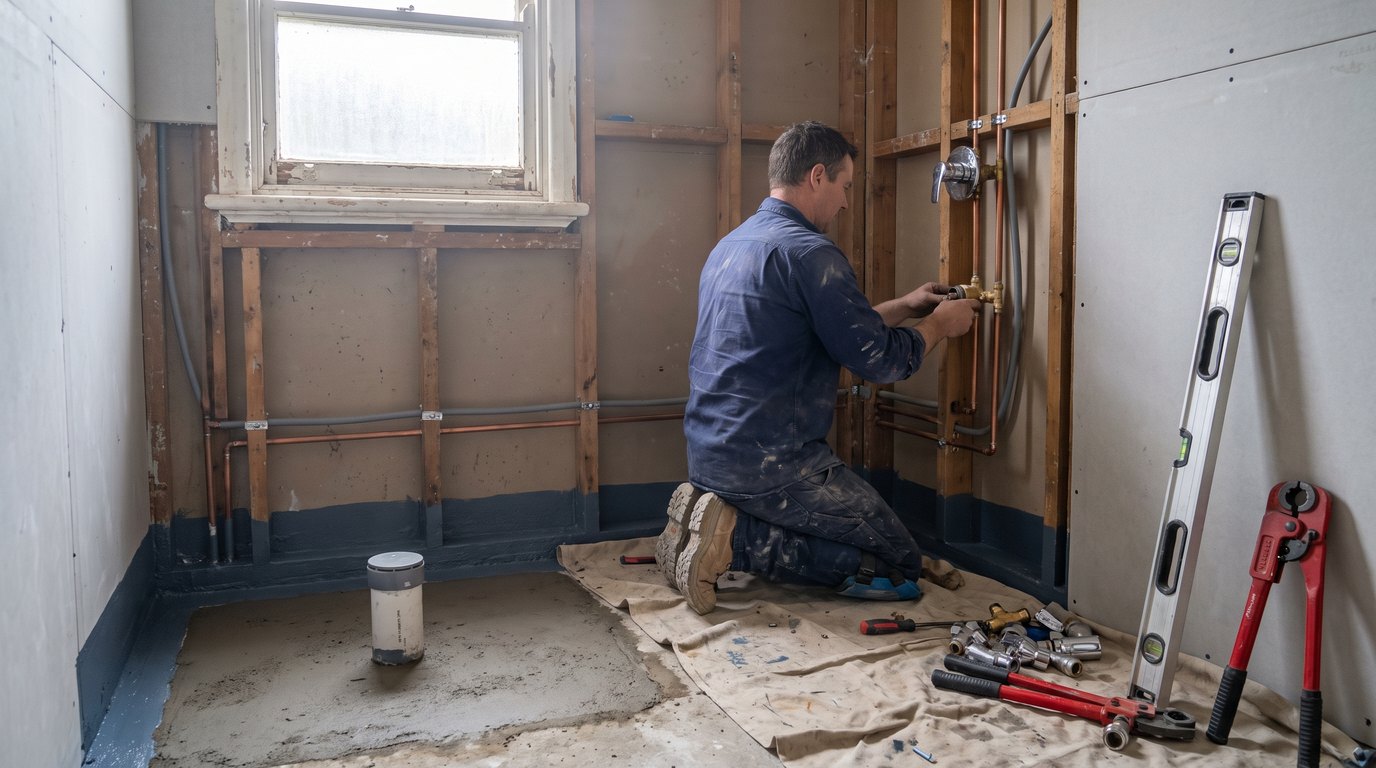
Before the tiles, the vanity and anything else you can see, the pipework goes in. That stage is the rough-in, and it locks in where your shower, bath, basin and toilet can physically sit. If you want to understand what happens at that point, our guide to bathroom plumbing rough-in walks through it.
Moving a toilet a metre looks like a small edit on a floor plan. In a home on a concrete slab, or with a tight run to the sewer connection, it can be the largest single line in the quote.
This is the argument for getting a plumber's view early rather than after the design is locked in. A layout that is easy to draw is not always a layout that is sensible to build, and finding that out at demolition stage is an expensive way to learn it.
Older Hobart homes change the job
Greater Hobart has a lot of older housing stock, and bathrooms in these homes tend to hold a few surprises behind the wall sheeting.
Things that regularly turn up on local jobs:
- Galvanised steel supply pipes that have narrowed with corrosion, which shows up as poor pressure once new fixtures go in
- Timber floors and bearers with rot around an old shower base that has been leaking slowly for years
- Limited or no wall insulation, which matters more here than in warmer parts of the country
- Restricted subfloor access on the steep blocks common through New Town, West Hobart and Sandy Bay
- Waste runs laid at shallow falls that limit where a new floor waste can go
The Tasmanian angle most renovation checklists miss is ventilation. Our heating season is long and our winters are cold and damp, so a Hobart bathroom spends months producing warm moist air against cold surfaces. That is the recipe for condensation and mould, and it will undo a beautiful renovation within a couple of winters.
An exhaust fan sized for the room and ducted to the outside, rather than venting into the roof space, is one of the cheapest decisions in the whole project and one of the easiest to skip. Raise it at quote stage, because it is far harder to add once the ceiling is closed up.
What the contract should cover before you sign
If your renovation has a contract price of $20,000 or more, Tasmania's residential building work rules apply and they give you real protections. Worth knowing:
- All contracts must be in writing, dated and signed by both parties
- The building contractor must give you a copy of the Residential Building Consumer Guide before you sign
- You have a cooling off period of five business days from receiving a copy of the signed contract and that guide. Withdrawing is not free, as the contractor can retain $100 plus reasonable out of pocket expenses incurred to that point
- Deposits are capped. The maximum is 10 per cent for contracts between $20,000 and $50,000, and 5 per cent for contracts of $50,000 or more
- Statutory warranties apply as law whether or not they appear in the contract, and they run for six years from the date of practical completion
Below that $20,000 threshold these specific rules may not apply, which makes it more important, not less, to get the scope, inclusions and exclusions written down before work starts.
Questions worth asking at quote stage
- Who holds the plumbing contractor's licence for this job, and what is the licence number?
- Is my job notifiable plumbing work, and who lodges the Notice of Work?
- Who does the waterproofing, and what documentation do I get at completion?
- What is specifically not included? Rubbish removal, painting, electrical and the shower screen are the usual gaps
- Who is on site day to day, and who do I call if something goes wrong six months later?
A contractor who answers all five without hesitating is showing you how the job will be run.
The red flags
Be cautious about a quote that is a single line and a single number, pressure to pay a large deposit before anything has been ordered, cash only arrangements with no written contract, and vagueness about who is licensed for what. None of these are proof of a problem on their own. Two or three together usually are.
Why we start from the plumbing
We come at bathrooms from the plumbing side first, because that is where the risk sits and where the cost of getting it wrong is highest. The pipework, the falls, the waterproofing and the compliance paperwork are the parts of a bathroom you will never see and never think about, provided they were done properly the first time.
If you are weighing up options across Greater Hobart, you can read more about how we approach bathroom renovations in Hobart, or work through our complete bathroom renovation guide if you are still at the planning stage.
Choosing well
Photos show you taste. Licences, categories of work, waterproofing documentation and a clear contract show you competence. Ask for the second set and the first tends to look after itself.
If you would like a licensed local team to look at your bathroom and talk through what the job actually involves, get in touch with Victory Plumbing Hobart and we will give you a straight assessment before any commitment.