Downpipe Problems: Blockages, Overflow and When to Replace
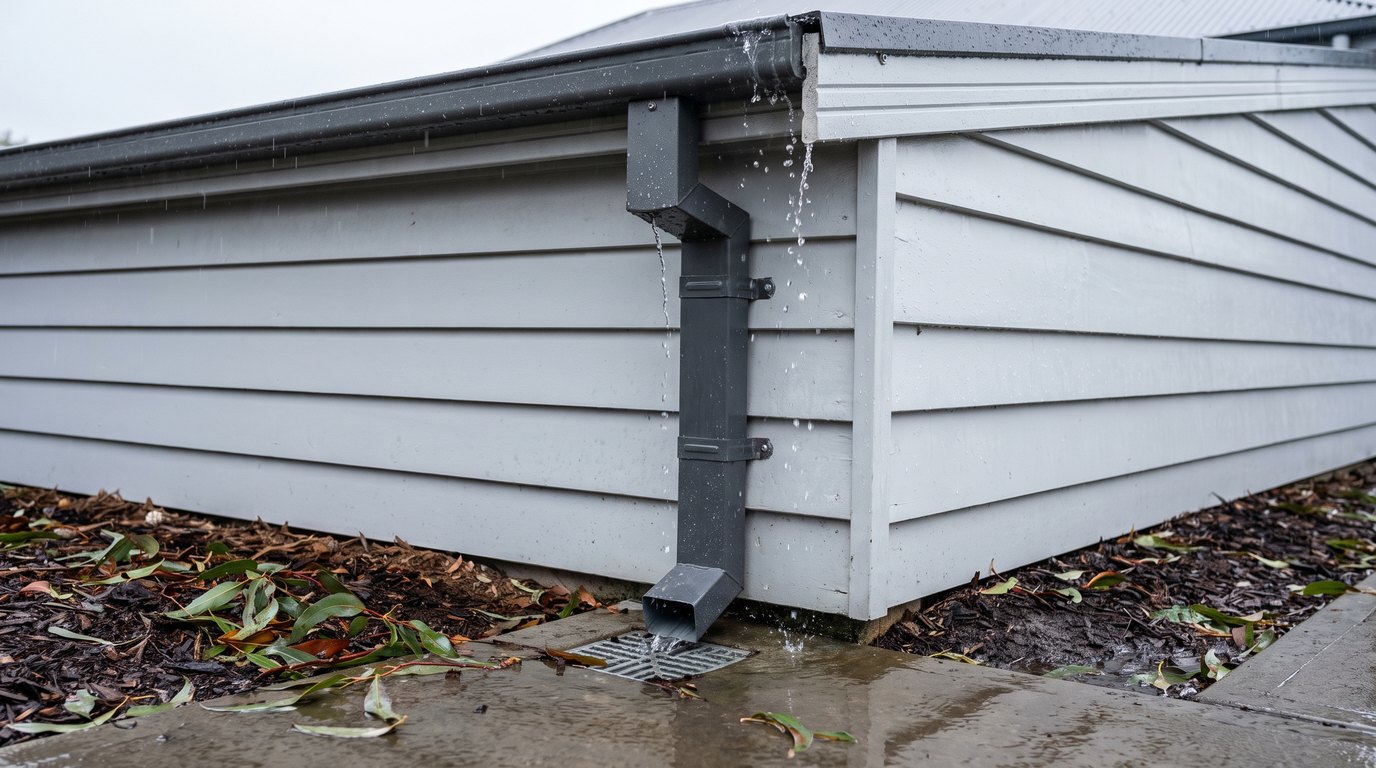
Your gutters are overflowing in the rain, but when you look up, the gutter itself seems reasonably clean. Nine times out of ten the problem is not the gutter at all. It is the downpipe.
Downpipes are the least looked at part of a roof drainage system and the easiest to ignore until water is running down a wall. Victory Plumbing Hobart sees the same handful of faults across Greater Hobart, and most of them are fixable well before they turn into a damp wall or a soaked subfloor.
This guide covers how to tell a blockage from actual damage, what you can safely check from the ground, and when a downpipe is better replaced than patched.
What a downpipe is meant to do
A downpipe carries rainwater from the gutter down to the stormwater system. It sounds simple, and it is, right up until one stops working.
Under the National Construction Code Housing Provisions, one downpipe must serve no more than 12 metres of gutter, and it must sit as close as possible to any valley gutter. The provisions cover four downpipe types: 75 mm round, 90 mm round, 100 x 50 mm rectangular and 100 x 75 mm rectangular.
That 12 metre rule matters when you are diagnosing overflow. If a long gutter run drains through a single pipe, the system has no spare capacity. Add a partial blockage and it will spill every time it rains properly.
Signs the downpipe is blocked
A blockage stops water moving. The clues usually show up above the restriction rather than at it.
- The gutter overflows near the downpipe outlet rather than at the ends
- Gurgling or trickling sounds from the pipe during rain
- Little or nothing coming out of the outlet while the gutter is clearly full
- Water still splashing at ground level well after the rain has stopped
- Moss, weeds or seedlings growing at the gutter outlet
Where the water spills is the most useful clue you have. A gutter that spills near the outlet is telling you the water cannot get away. A gutter that spills evenly along its whole length usually points at the gutter's fall or its size instead.
Signs the downpipe itself is damaged
Damage lets water escape. That is the opposite symptom and it needs a different fix.
- Water dripping from a joint partway down the pipe
- Rust streaks, splits or pinholes, usually low down where wet debris sits
- The pipe pulling away from the wall, or brackets that have let go
- A section that has separated at the swan neck or at the shoe
- Staining, damp render or a musty smell on the wall behind the pipe
If water is leaving the pipe somewhere it should not, you are looking at damage. If water is backing up above the pipe, you are looking at a restriction. Sorting the two before anyone starts work saves a lot of guessing.
Why an overflowing gutter is not always a fault
This one surprises people. Overflow is a deliberate part of Australian gutter design, not automatically a defect.
The National Construction Code requires gutters to include a way for water to escape safely in extreme rain, sized to cope with a five minute burst at a one per cent annual exceedance probability. Gutters themselves are sized for a more common five per cent event.
Those overflow measures can be continuous, such as slots along the front face of the gutter or a controlled gap behind it, or dedicated, such as an end stop weir, an inverted nozzle or a rainhead.
So water spilling over the front of a gutter during a genuine downpour may be the system doing exactly what it was designed to do. Water spilling in ordinary steady rain is not. That distinction is worth making before anyone pulls a downpipe apart.
What Hobart rain does to downpipes
Hobart's rainfall pattern is unusual, and it changes how downpipe faults show up here.
The Bureau of Meteorology's long record for Hobart shows a mean annual rainfall of about 611 mm spread across roughly 160 rain days a year. That is a lot of wet days for a modest total, and the monthly figures are remarkably even.
The practical result is that Hobart gets frequent light and steady rain rather than the short violent bursts that dominate further north. A partly blocked downpipe here often does not announce itself with one dramatic flood.
Instead it trickles down a wall for months. The first sign is usually a damp patch, lifting paint or a soft weatherboard rather than water pouring over a gutter, and by then the repair is a building repair as much as a plumbing one.
Cold matters too. Debris that stays wet through a Hobart winter holds moisture against steel at the base of the pipe, which is precisely where we find most rust holes.
What you can safely check from the ground
Keep it at ground level. Roof and ladder work in wet weather is the most dangerous part of any downpipe job, and there is very little you can learn up there that you cannot infer from below.
- Watch during rain and note exactly where the water is spilling
- Look at the base of each downpipe for splashback, a scoured garden bed or a puddle that lingers
- Check the wall behind and beside the pipe for staining, damp or moss
- Look for a separated joint, a loose bracket or a pipe that has shifted
- Note whether the problem happens in light rain or only in a heavy fall
One thing to avoid: do not push a hose, a rod or drain chemicals down a downpipe. If the blockage is below ground you can pack it tighter, and if the pipe is already cracked you can turn a clearing job into an excavation.
Blockage, repair or replacement
The right answer depends on what is actually wrong, which is why we would rather look before quoting.
When clearing is enough
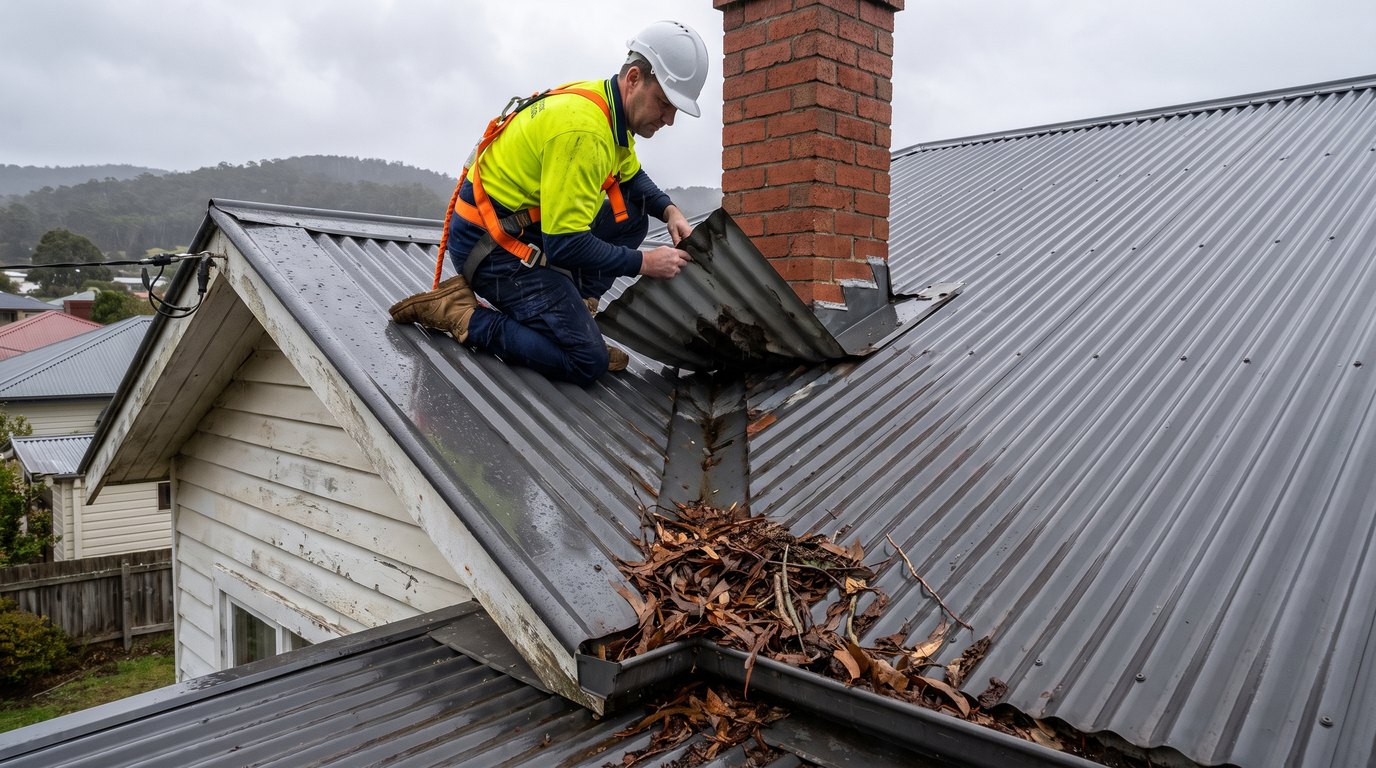
Leaf litter, roof grit, silt or a bird's nest in a pipe that is otherwise sound. This is the common case on Hobart blocks with gums or stringybarks near the roofline.
When a repair makes sense
One leaking joint, one failed bracket or a single damaged section on a pipe that is in good condition elsewhere and correctly sized for the gutter feeding it.
When replacement is the better call
Rust across several sections, splits, a pipe that has already been patched more than once, or a downpipe that is plainly undersized for its gutter run. Repeatedly repairing a pipe that keeps failing costs more over time than replacing it once.
A downpipe is one part of a system, so it helps to understand how gutters and downpipes protect your home before making a call on a single pipe.
When the problem is not the downpipe at all
Two situations catch Hobart homeowners out regularly.
The first is a spreader. Where an upper roof drains onto a lower roof, the upper downpipe discharges through a spreader into the lower gutter. If that spreader is undersized, poorly aimed or blocked, the lower gutter floods and the lower downpipe gets the blame.
The second is the stormwater connection past your boundary. The City of Hobart owns over 350 kilometres of stormwater pipe and maintains more than 60 kilometres of waterways and creeks. Connections from a private property into that public system are arranged through the council and done at the owner's cost.
If every downpipe on the house is clear and water still backs up, the restriction may be in the underground line rather than anywhere you can see.
Preventing the next blockage
- Clear gutters before and after the heaviest leaf drop, and more often if you have gums nearby
- Fit mesh or a leaf guard at the gutter outlet rather than jamming something into the pipe itself
- Keep overhanging branches cut back, and get permission before touching anything growing on a neighbour's land
- Check fixings once a year; the Housing Provisions expect gutter brackets at no more than 1.2 metre spacing, and downpipe brackets deserve the same attention
- Walk the perimeter after the first solid rain of autumn and look at the base of every pipe
Getting it sorted properly
In Tasmania, roof plumbing and stormwater drainage are licensed plumbing work. A standard Tasmanian plumbing licence covers the water, sanitary, drainage and roof stormwater streams, so whoever works on your downpipes should hold one.
If your downpipes are overflowing, leaking or simply looking past their best, the roof plumbing team at Victory Plumbing Hobart can inspect the full run, from the gutter outlet through to the stormwater connection, and tell you honestly whether it needs clearing, a repair or replacement.
If replacement turns out to be the answer, choosing Colorbond gutters and downpipes for your home is the next thing worth working through.
Frequently asked questions
Why is my downpipe overflowing at the bottom?
Water backing up and spilling at the base usually means the restriction is at or below the outlet, in the shoe, the connection or the underground stormwater line. A pipe that is clear along its length but still overflowing at ground level points past the downpipe itself.
How do I tell whether the blockage is in the downpipe or underground?
Run water into the gutter and watch. If it disappears into the pipe and then surges back at the bottom, the restriction is low down or underground. If it never moves at all, the blockage is higher up, often at the swan neck.
Can I clear a blocked downpipe myself?
You can safely clear visible debris from a gutter outlet at ground level. Anything involving ladders, roof access, dismantling pipe sections or the stormwater connection is worth handing to a licensed plumber, both for safety and because the wrong tool can make the blockage harder to reach.
How often should downpipes be checked?
Twice a year suits most Hobart homes, timed around autumn leaf drop and before winter. Homes surrounded by trees, or on blocks that catch the wind off the river, are worth checking more often.