Gas Hot Water Systems in Hobart: Pros, Cons and Running Costs
Gas is often described as the cheap, reliable way to heat water in an Australian home. That advice is written for the mainland, and it does not translate cleanly to Tasmania.
Victory Plumbing Hobart installs and services gas hot water across Greater Hobart, and the first question is usually not which unit to buy. It is whether gas makes sense for that particular house at all.
Here is an honest look at how gas hot water systems work, what they cost to run, where they still make sense in Hobart, and the local details that most national buying guides leave out.
First, Can You Actually Get Gas Where You Live?
Natural gas is far less widespread in Tasmania than it is in Melbourne or Sydney. Tas Gas Networks has rolled out around 789 kilometres of network since 2003, reaching more than 58,000 Tasmanian properties across Hobart, Launceston, Longford, Westbury, Bell Bay, Wynyard, Devonport and Burnie.
That sounds like a lot until you compare it with the number of homes in the state. Plenty of Hobart streets have no reticulated gas at all, and coverage can change from one block to the next.
If your street is not on the network, gas hot water means bottled LPG. That still works well, but it changes the economics significantly, because LPG generally costs more per unit of energy than natural gas and the bottles need swapping or refilling.
So the sequence matters. Check availability at your address first, then choose a system. Sizing a unit you cannot fuel is a common and expensive mistake.
The Two Types of Gas Hot Water System
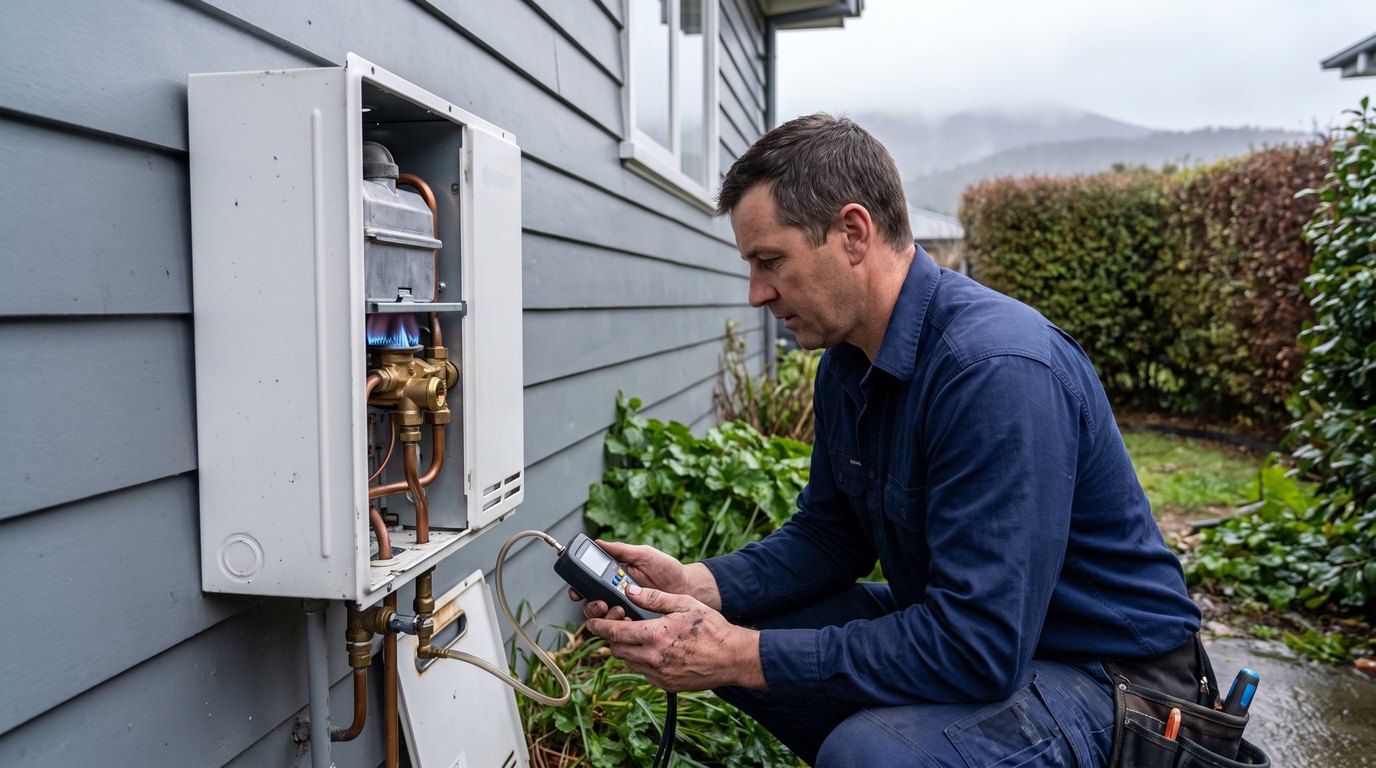
Every gas system heats water using the same three components: a burner, a heat exchanger and a thermostat. The difference is when the heating happens.
Gas storage
A storage system heats water in an insulated cylinder and keeps it hot until you use it. It handles simultaneous demand well, so a household running a shower, the dishwasher and the laundry at once will not usually notice a drop.
The trade-off is standing heat loss. The cylinder is reheating water around the clock whether anyone uses it or not, which is where a chunk of the running cost goes.
Continuous flow
Continuous flow units, also called instantaneous, heat water only as it passes through. There is no tank, so no standing loss, and you do not run out during a long shower.
The catch is that they draw gas at a high rate while running. Some homes need an upgraded gas line or meter to supply one properly, and that cost surfaces at installation rather than on the quote for the unit itself.
Which suits which household
Continuous flow tends to suit smaller households, homes with staggered hot water use, and holiday or rental properties that sit empty between stays. Storage tends to suit larger households with heavy overlapping demand, particularly where the gas supply will not comfortably feed a high-output continuous unit.
Neither is universally better. The right answer depends on your gas supply, your peak demand and where the unit can physically go.
What Gas Does Well
Gas heats water quickly, which matters most for storage systems recovering after heavy use. A gas cylinder typically reheats faster than an equivalent electric one.
It also runs independently of your electricity supply in some cases. Certain continuous flow models need no power point at all, which is genuinely useful in areas that lose power during winter storms.
And it is familiar. If your home already has a gas connection, a meter and a compliant flue, replacing like with like is usually the simplest and least disruptive option.
What Gas Does Less Well in Tasmania
This is where local context changes the picture. Tasmania generates enough renewable electricity to be self-sufficient, largely from hydro and wind. The usual mainland argument that gas is the lower-emissions choice compared with coal-fired electricity does not hold here in the same way.
There is also no financial incentive pushing you towards gas. Federal small-scale technology certificates, which effectively discount the purchase of a heat pump or solar hot water system, do not apply to gas. Choosing gas means paying full freight on the unit.
If your home is on bottled LPG rather than mains gas, the running cost gap widens further. For those households it is worth genuinely comparing a heat pump before defaulting to a gas replacement.
None of that makes gas the wrong choice. It does mean the decision deserves more thought here than a national buying guide would suggest.
What Actually Drives the Running Cost
Three things matter more than the brand on the front of the unit.
The first is the energy rating. Most gas storage systems carry a Gas Energy Rating between 4 and 5.3 stars, while most continuous flow units sit between 5 and 6 stars, with some reaching 7. Looking for at least 5 stars is sound advice, and the difference compounds over the ten or more years you will own it.
The second is your fuel. Mains natural gas and bottled LPG are not interchangeable on cost, and a system that looks affordable on natural gas can be noticeably dearer to run on bottles.
The third is how your household actually uses hot water. A storage system suits steady, predictable demand. If your house is empty all day and everyone showers within the same hour, a continuous flow unit will usually waste less.
Anyone quoting you a precise annual running cost without knowing your fuel, your usage and your tariff is guessing. We will give you a written quote for the work, but a genuine running cost estimate needs your actual bills.
Is Gas Hot Water Being Phased Out?
This comes up constantly, and the answer depends entirely on which state you are reading about.
Victoria began phasing out new gas connections for new dwellings and residential subdivisions requiring planning permits from 1 January 2024, and the ACT has moved in a similar direction. Those policies get national coverage, which is why the question feels urgent everywhere.
Tasmania has not introduced an equivalent ban on new residential gas connections. If you have gas now, you can replace a gas hot water system with another one.
That said, the long-term direction of travel across the country is worth factoring in if you are choosing a system you expect to keep for a decade or more. It is a consideration, not an emergency.
Rebates: What Tasmanians Can Actually Get Right Now
Be careful with what you read here, because a lot of it is out of date.
Tasmania's Energy Saver Loan Scheme, which offered interest free loans of up to $10,000 for energy efficient upgrades including hot water, closed to new applications on 1 September 2025. A number of installer and comparison websites still promote it as though it were open.
Federal small-scale technology certificates remain available, but only for heat pump and solar hot water systems, not for gas. If incentives are a significant part of your decision, that points away from gas rather than towards it.
Choosing between the two is its own decision, and comparing a heat pump against gas is worth doing properly before you commit.
How Long Should a Gas System Last?
Industry guidance puts the working life of a gas hot water system at roughly 10 to 20 years, with continuous flow units generally at the longer end and storage cylinders at the shorter end.
Warning signs are fairly consistent: water that runs lukewarm before it runs hot, rust staining, moisture pooling at the base of a cylinder, and a system that needs repeated repairs to keep going.
Knowing when to replace rather than repair is the difference between a planned installation and a cold shower in July. Any gas hot water work, including the installation itself, must be carried out by a licensed gas fitter, so this is not a job to attempt yourself.
If you would like an honest assessment of what suits your home, our hot water services in Hobart cover gas, electric and heat pump systems across Greater Hobart and the surrounding suburbs.
Frequently Asked Questions
Is gas hot water cheaper to run than electric in Tasmania?
It depends on your fuel and your tariff. On mains natural gas it often is, compared with a conventional electric storage system. Against a modern heat pump, and particularly if you are on bottled LPG, the gap narrows or reverses. Compare using your own bills rather than a national average.
Do I need electricity for a gas hot water system?
Some continuous flow models run entirely on gas and need no power point, which is useful during outages. Many others do require power for ignition and controls, so check the specification before assuming yours will work in a blackout.
Can I install a gas hot water system myself?
No. Gas work in Tasmania must be carried out by a licensed gas fitter. Beyond the legal position, an incorrectly installed or flued gas appliance is a carbon monoxide risk, and insurers take a dim view of unlicensed work.
What size gas hot water system do I need?
It depends on how many people live in the house and when they use hot water, not just the number of bathrooms. For continuous flow the relevant figure is flow rate in litres per minute; for storage it is tank capacity plus recovery rate. A licensed plumber will size it against your actual demand and your available gas supply.
My gas hot water has gone cold. What should I check first?
Check whether the pilot light or ignition has failed, whether the gas supply is on, and if you are on LPG, whether the bottle is simply empty. If those are all fine, the fault is likely in the thermostat, the burner or the heat exchanger, and it needs a licensed gas fitter to diagnose safely.