Bathroom Renovation in Hobart: Where to Start
A bathroom renovation is the job most Hobart homeowners put off the longest, and it is usually because the first decision is unclear. Tiles, tapware and vanity styles feel like the natural starting point. They are actually among the last things that should be locked in.
Victory Plumbing Hobart works on bathrooms right across Greater Hobart, from older weatherboard homes in the inner suburbs through to newer builds out toward Kingston and Brighton. The order you make decisions in has far more effect on your budget and your timeline than the finishes you pick. This guide walks through that order, and through the Tasmanian approval requirements that catch people out.
Start with scope, not style
Every quote you receive will be shaped by one question: how far back are you stripping the room? Answer that before you speak to anyone, because it determines who you need on site, which approvals apply, and how many weeks you are without a bathroom.
Most projects fall into one of three brackets.
A cosmetic makeover
The bones stay exactly where they are. You might replace tapware and a showerhead like for like, resurface a bath, regrout, swap a mirror cabinet or repaint. Nothing moves, nothing opens up.
This is the shortest and least disruptive option. It suits rental properties, a tidy-up before selling, or a bathroom that works well but looks tired.
A remodel in the same footprint
The room is stripped back to the substrate, but the shower, bath, basin and toilet stay in the same positions. New tiles, new waterproofing, new vanity, new screen, new fixtures.
This is where most family bathrooms land. You get what feels like a completely new room without the cost of relocating services, and it is the sweet spot for value in most Hobart homes.
A full renovation with layout changes
Walls, plumbing and sometimes windows move. The bath comes out and a walk-in shower goes in, the toilet shifts to a different wall, or the room is opened into an adjoining space.
This delivers the biggest transformation and carries the biggest cost, longest timeline and most compliance steps. It is the right call when the existing layout genuinely does not work, not when you simply want a different look.
The single decision that moves your budget most
Relocating plumbing is the line where a straightforward job becomes a complex one. Moving a toilet, shower waste or bath means new drainage, new falls, more demolition, and often cutting into a slab or reworking floor framing.
That work is slow, it needs to be right the first time, and it pulls in more trades and more inspection points. If you are weighing up a layout change, ask your plumber early which specific moves trigger new drainage rather than a simple extension of existing pipework. The answer will often let you get most of the look you want for a fraction of the cost.
A good rule of thumb for Hobart homes: keep the wet wall where it is if you possibly can. Everything else is negotiable.
What older Hobart homes tend to hide
Plenty of homes across Hobart were built well before current wet area rules existed, and demolition day is when that becomes obvious. Being prepared for it is the difference between a variation you expected and a shock.
The usual finds are galvanised steel supply pipes near the end of their life, no floor waste at all, timber or particleboard flooring that has been quietly wet for years, and either a failed waterproof membrane or none whatsoever. Framing behind a leaking shower is a common one, and it is not visible until the tiles come off.
Homes built before the early 1990s may also contain asbestos in wall and ceiling sheeting, particularly in wet areas. It should never be cut, sanded or drilled on a hunch. If there is any doubt, stop and have the material assessed before demolition continues.
Build a contingency into your planning for this. A renovation quote is priced on what can be seen, and in an older home there is always something that cannot be.
Approvals in Tasmania: what is notifiable and what needs a permit
This is the part national renovation guides get wrong, because Tasmania runs its own risk-based system under the Building Act 2016. Work is sorted into low risk, notifiable (medium risk) and permit (high risk) categories, and a bathroom renovation usually sits in the middle band.
Plumbing work
Under the Director's Determination on categories of plumbing work, installing new fixtures in a bathroom is notifiable work. That means a Notice of Work goes to the council permit authority, a Certificate of Likely Compliance is obtained, and the work must be carried out by a licensed plumber. The council also inspects the plumbing at set stages and issues a Certificate of Completion at the end.
Low risk plumbing covers repairs and like for like changes of fixtures and fittings. As an owner you can do a very small amount of this yourself on your own home, such as changing a tap washer or swapping a showerhead like for like. Anything beyond that short list must be done by a licensed plumber, and penalties apply for unlicensed work.
A smaller number of jobs are permit work and need a plumbing permit from council. On-site wastewater management systems and backflow prevention devices are the usual examples, which is worth knowing if your property is not on reticulated sewer.
Building work
If your renovation involves structural change, such as removing or moving a wall, that is generally notifiable building work as a residential alteration. It needs a Notice of Work to a licensed building surveyor and a Certificate of Likely Compliance, with the council notified that the work is happening.
You can check any plumber, builder or building surveyor's licence through the Tasmanian occupational licensing register before you sign anything. It takes about a minute and it is the cheapest due diligence available.
Waterproofing is the part you never see
Waterproofing is invisible once the tiles go on, which is exactly why it is the worst place to save money. In a cool, damp climate a failed membrane does not announce itself for a year or two, and by then the damage has moved into the framing.
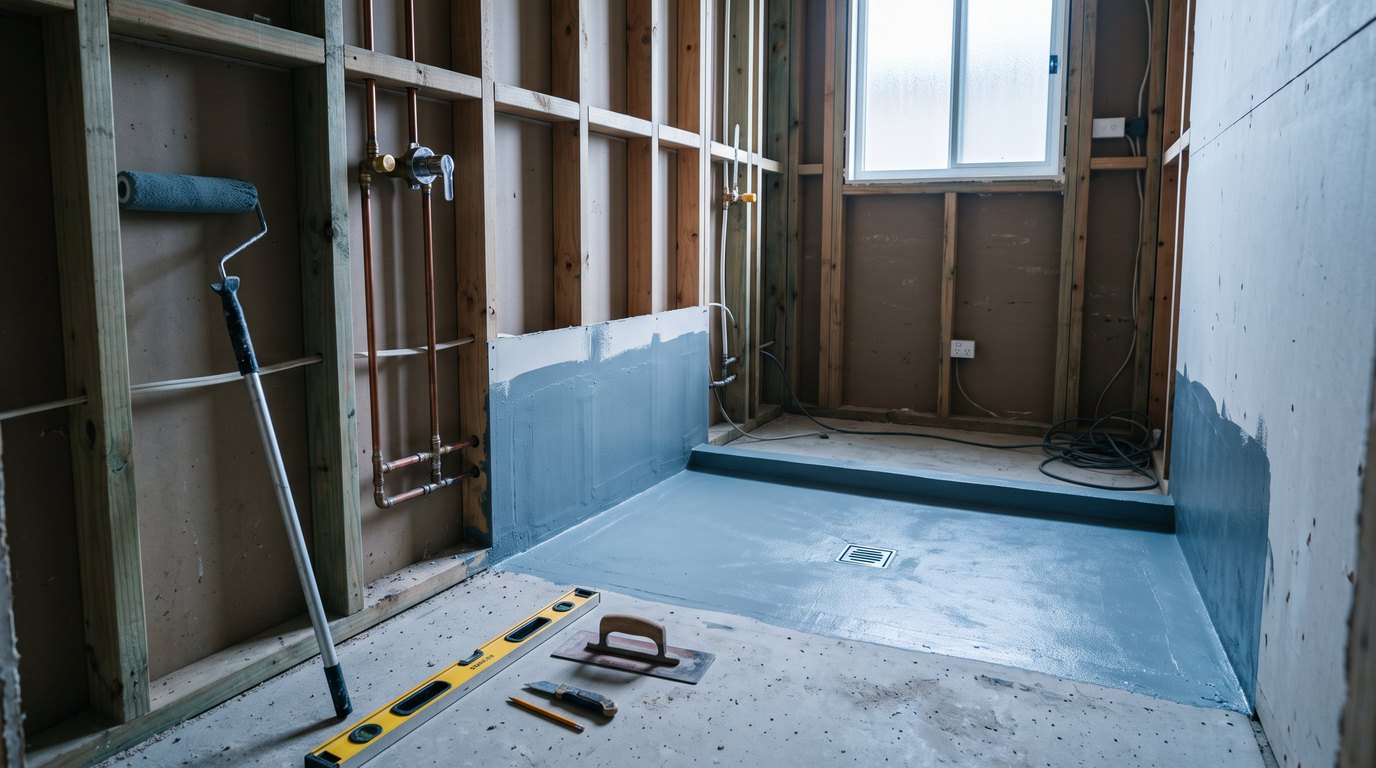
The requirements sit in the National Construction Code Housing Provisions and AS 3740, the Australian Standard for waterproofing domestic wet areas. Shower walls generally need to be waterproofed to a height of 1,800 mm, junctions and penetrations need to be sealed properly, and floors need correct falls so water actually reaches the waste.
Two practical things to insist on. Ask that the membrane be given its full curing time before tiling starts, and ask for photographs of each stage plus the compliance paperwork at handover. Keep those with your property documents. If you ever sell or make an insurance claim, they matter.
Ventilation and condensation in a cool climate
Hobart sits in National Construction Code climate zone 7, classified as cool temperate. That has a real consequence for bathrooms that renovators in warmer states rarely have to think about: warm moist air meeting cold surfaces, over and over, through a long winter.
Get the ventilation right at the design stage rather than treating the exhaust fan as an afterthought. Exhaust air from a bathroom generally has to be discharged to the outside of the building rather than dumped into the roof space, because venting moist air into a cold roof cavity simply relocates the condensation problem.
CBOS publishes a Tasmanian designers' guide on condensation in buildings for exactly this reason. It is written for designers, but the principle for homeowners is simple. In a Hobart bathroom, ventilation and heating are not luxuries, they are what stops mould returning six months after a renovation. A fan sized for the room, ducted properly to outside, and run on a timer after showers, will do more for the longevity of your new bathroom than an upgraded tile.
The contract that protects you
Tasmania has specific consumer protections for residential building work, and they apply to most bathroom renovations of any real size.
Where the contract price is $20,000 or more, the Residential Building Work Contracts and Dispute Resolution Act 2016 applies. Your building contractor must give you a copy of the Residential Building Consumer Guide before you sign, and the contract must be in writing, dated and signed by both parties, including the contractor's licence number, a clear description of the work, the price or the method of calculating it, and the practical completion date.
A few points worth knowing before you sign anything:
- You have a cooling-off period of five business days from receiving a copy of the signed contract and the Consumer Guide. Getting formal legal advice on the contract first ends that right.
- Deposits are capped. The maximum is 10 per cent for contracts between $20,000 and $50,000, and 5 per cent for contracts of $50,000 or more.
- Variations must be in writing and signed by both parties, with the new price stated. Verbal agreements on site are how budgets drift.
- Statutory warranties apply as law whether or not they are written into the contract, and they last six years from practical completion. They transfer to a new owner if you sell within that period.
- If a building surveyor or the Director of Building Control certifies work as defective within 24 months of a Certificate of Completion, a Defective Work Order can be issued to the contractor.
If something goes wrong, the pathway is to raise it with your contractor first, then CBOS for advice, then formal mediation, and finally the Tasmanian Civil and Administrative Tribunal. Skipping steps will get an application knocked back.
A realistic sequence and timeline
Bathrooms take longer than people expect, not because any single stage is slow, but because the stages cannot overlap. Each trade waits on the one before it.
The usual order runs like this:
- Demolition and strip-out, including removal of the old membrane and any damaged substrate.
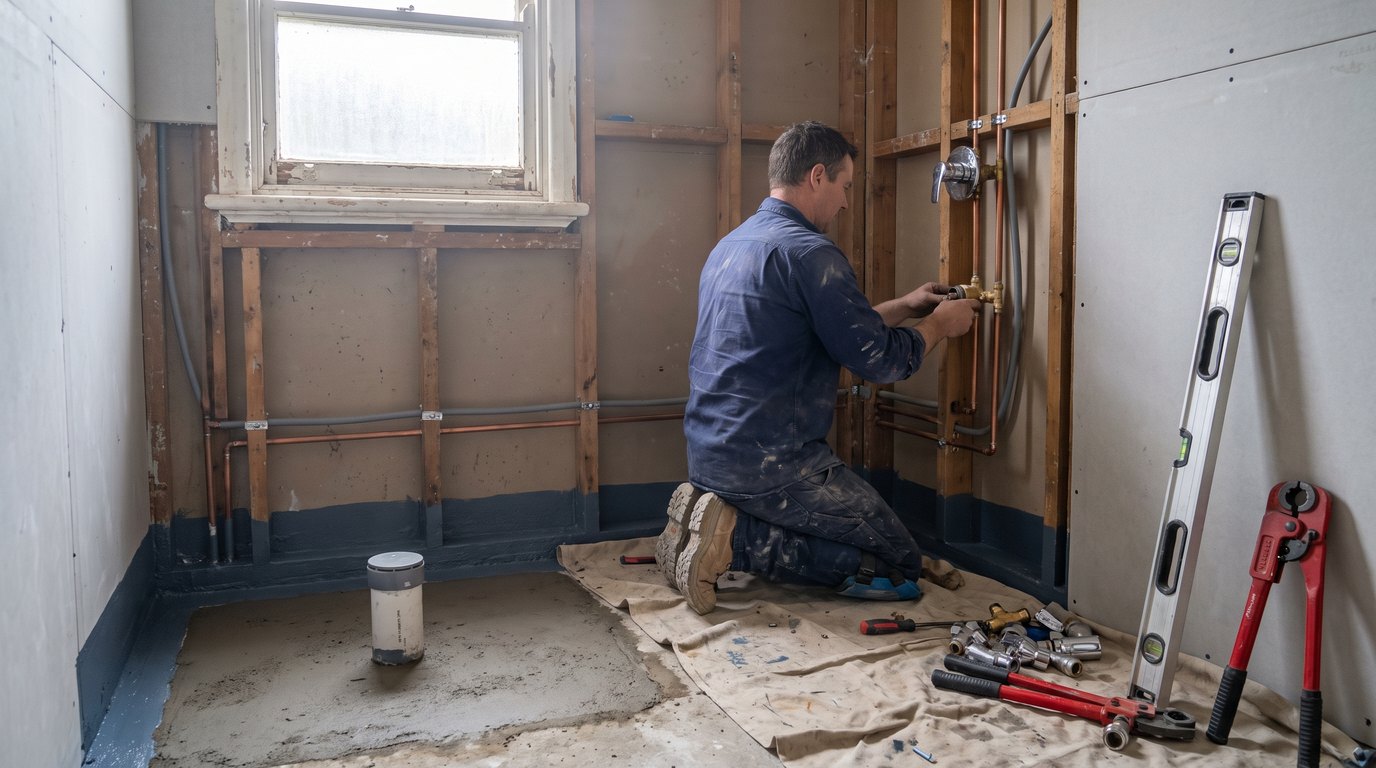
- Rough-in, where the plumbing and electrical are set into walls and floors. This is the bathroom plumbing rough-in stage, and it is the one that has to be exactly right, because it is buried behind tiles for the next twenty years.
- Sheeting, screeding and waterproofing, with curing time built in.
- Tiling, then grouting.
- Fit-off, when the vanity, toilet, screen, tapware and accessories go in.
- Silicone, painting, final inspections and certificates.
A cosmetic makeover can be done in days. A remodel in the same footprint is typically a matter of weeks on site once materials are on hand. Layout changes stretch that out further. Timelines vary with the size of the room, the trades available and what turns up during demolition, so treat any number you are given as an estimate until the walls are open.
The biggest avoidable delay is product lead times. Lock in your tiles, vanity, screen and tapware before demolition starts, not during. A back-ordered vanity can hold up a finished bathroom for weeks.
Where the money actually goes
Most of a bathroom budget is spent on things you will never look at. Demolition, waste removal, plumbing, electrical, substrate repairs and waterproofing consume a large share before a single tile is laid, which is why bathrooms cost more per square metre than almost any other room in the house.
The variables you control are scope, layout changes and the specification of your fixtures and finishes. The variables you do not control are what is behind the walls and how much of it needs rectifying. Every honest quote you receive will be for a defined scope, and the correct question to ask is not just "how much" but "what happens to this price if you find rot, or asbestos, or no floor waste".
For a breakdown of how individual items such as the vanity, shower screen, toilet and tiling contribute to a total, our fixture by fixture price breakdown covers each element in turn. If you would like an actual figure for your bathroom, the only reliable path is an on-site assessment. Our bathroom renovation service in Hobart starts with a look at the existing room and the services behind it, because a quote written without that is a guess.
Mistakes that cost the most
A short list, drawn from the jobs that go sideways.
- Choosing finishes before scope. It sets an emotional budget that the structural reality then has to fit into.
- Changing the layout after work has started. Late relocation of a toilet or shower is the most expensive variation there is.
- Treating waterproofing as a line item to trim. It is the one part of the job you cannot inspect later without demolition.
- Undersized or badly ducted ventilation. In a Hobart winter this shows up as mould within a season.
- Accepting a quote that is far below the others. Something has been left out, and it is usually preparation, waterproofing or licensed labour.
- No written variations. The budget does not blow out in one decision, it blows out in nine small undocumented ones.
Where to start this week
You do not need to have chosen a single tile to make progress. Three steps will put you well ahead.
Walk the room and write down what does not work, separating the problems that are about layout from the ones that are about condition or appearance. Decide honestly which of the three scope brackets you are in, and whether a layout change is worth what it will cost. Then get a licensed plumber into the room to tell you what is actually behind the walls and what the approval pathway looks like for your specific job.
From there, quotes become comparable, timelines become realistic, and the fun part, choosing how it will look, sits where it belongs: at the end of the planning, not the start.
If you are planning a bathroom renovation anywhere in Greater Hobart, Victory Plumbing Hobart can walk the room with you, explain the notifiable work and certification steps that apply, and give you a written quote based on what is really there.