Instant Hot Water System vs Storage: Which Suits Your Hobart Home?
"Instant" and "storage" describe when a system heats your water, not how well it heats it. That single difference drives almost everything else: what it costs to run, what the installation involves, and whether anyone gets a cold shower on a Sunday morning.
Victory Plumbing Hobart installs and services both types across Greater Hobart. Neither is better in general terms, but one of them is usually clearly better for a specific house.
Here is how each one works, what the choice actually costs in Tasmania, and how to size whichever you land on.
How an Instant Hot Water System Works
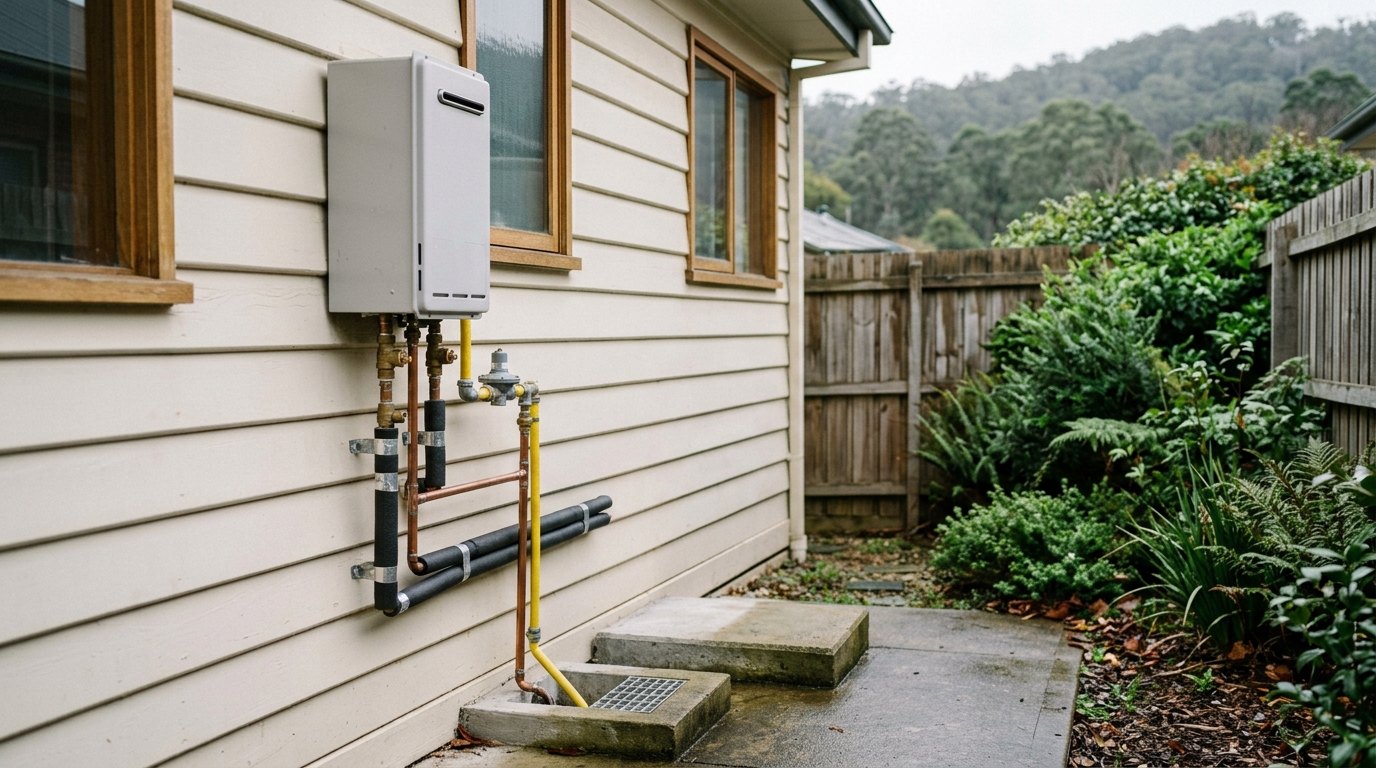
An instant hot water system, sold variously as continuous flow, instantaneous or tankless, heats water only while it is moving through the unit.
Open a hot tap and a flow sensor picks up the movement. That fires a gas burner or switches on an electric element, and the water absorbs heat as it travels through a coiled heat exchanger on the way to the tap.
There is no tank, so nothing sits there losing heat overnight. There is also no fixed volume to run out of, which is why these units are sold on the promise of never running out of hot water.
The trade-off is that all the energy has to arrive at once. A gas unit draws gas at a high rate while it is running, and an electric unit draws a large amount of power.
How a Storage System Works
A storage system heats water in an insulated cylinder and holds it until someone uses it. Hot water is drawn from the top, cold water refills the bottom, and the next heating cycle brings it back up to temperature.
Because the energy arrives gradually rather than all at once, a storage system can run off a modest electrical circuit or a standard gas supply.
The cost of that convenience is standing heat loss. The Australian Government's Your Home guide notes that heat loss from a storage tank and its associated fittings and pipes can be up to one third of the system's total energy consumption.
The Tasmanian Detail That Changes the Maths
This is where national buying guides tend to fall over.
The standard argument goes: instant systems have no standing heat loss, so they are cheaper to run. On efficiency alone that holds up. Your Home puts electric instantaneous systems at roughly 20 to 30 per cent more efficient than electric storage.
Efficiency is not the same as cost, though, because in Tasmania the price you pay for electricity depends heavily on when you use it.
Aurora Energy's Off-Peak Night Only tariff, Tariff 62, is generally used for things like hot water systems and is available for nine hours between 10pm and 7am. As at 1 July 2026 it is priced at 14.0217 cents per kilowatt hour.
Compare that with the Peak and Off-Peak plan, Tariff 93, where peak power is 36.1878 cents per kilowatt hour, and weekday mornings from 7am to 10am sit right in the peak window.
A storage cylinder can do its heating overnight on the cheaper circuit. An instant system cannot, because it heats at the exact moment someone turns on the shower, which for most households is when power is dearest.
That is why Your Home observes that electric instantaneous systems are often more expensive to run than storage systems despite being more efficient. In Tasmania, with that size of price gap, the point lands harder than it does on the mainland.
The same logic applies to rooftop solar. A storage tank can soak up cheap midday generation on a timer. An instant unit heats when you happen to want hot water, and in winter that is rarely the middle of the day.
One related point worth knowing: Tariffs 31 and 41, the old flat rate lights and power and heating and hot water combination, have not been available to new connections since 1 July 2024. Households that already have them keep them, but a new install cannot be put on them.
Gas Shifts the Comparison Again
If your home is on gas, the electricity tariff argument does not apply, and the efficiency case for instant is more straightforward.
Canstar's October 2025 figures put the average annual running cost of a gas water heater in Hobart, at 200 litres of hot water per day, at roughly $1,053 for an instantaneous unit against $1,226 for storage. Those numbers move with gas prices and household usage, so treat them as a direction rather than a quote.
The catch in Hobart is availability. Reticulated natural gas is far less widespread here than in Melbourne or Sydney, and if your street is not on the network then gas means bottled LPG, which Your Home puts at around two to three times the running cost of natural gas. We have covered the local picture in more detail in our guide to gas hot water systems.
If you are replacing an electric system and want the lowest running cost rather than the lowest purchase price, it is also worth looking at how a heat pump compares before defaulting to either instant or storage.
Sizing: Litres Per Minute Against Litres in a Tank
The two system types are sized on completely different measures, and this is where most undersized installations start.
Storage is sized by volume
Your Home suggests one person uses about 50 litres of hot water a day, while stressing that you should assess your own household rather than rely on an average. Everyone showering inside the same hour needs more capacity than the same number of people spread across the morning.
There is a second consideration specific to off-peak heating. Your Home notes that storage systems larger than 250 litres are better suited to controlled load operation, because a smaller tank can lose heat quickly and run out before the off-peak circuit switches back on.
So if the cheap overnight tariff is the reason you are choosing storage, the tank needs to be big enough to actually make use of it. Undersizing there quietly cancels out the saving you were chasing.
Instant is sized by flow rate
Continuous flow units are rated in litres per minute, and that rating is always quoted at a nominated temperature rise, which is the number of degrees the unit has to lift the incoming water.
That matters in Tasmania. Colder incoming mains water in a Hobart winter means a larger temperature rise to reach the same delivered temperature, which means less usable flow than the headline number suggests. Always ask what temperature rise a quoted flow rate is based on.
Outlet count matters too. Your Home notes that standard instantaneous gas units can supply adequate hot water to only one or two locations around the home at once, while high-performance units can handle three or more.
What the Installation Actually Involves
Instant systems tend to look cheaper on the unit price and then surprise people at installation.
A gas instant unit needs a high gas flow rate while it runs. Your Home notes this may require larger gas pipes or a larger meter, and instantaneous LPG systems generally need a large supply pipe of their own.
Electric instant units are more demanding again. Your Home puts their draw at up to 28 kilowatts when operating, which usually requires a three-phase connection that not every Hobart home has. Single-phase units exist, but their flow rates are very limited, making them suitable for basins rather than showers.
There is also a compatibility issue worth raising before you buy a water-saving showerhead. Some instantaneous gas systems run erratically at low flow rates and may shut down for safety, so Your Home recommends checking showerhead compatibility with the water heater manufacturer.
None of this makes instant the wrong choice. It does mean the quote you should be comparing is the installed price, not the price on the box.
Safety and Compliance
All hot water systems must be designed and installed in accordance with Section 8 of AS/NZS 3500.4:2021, and the work must be done by a licensed plumber. Gas work requires a licensed gas fitter.
Stored hot water in a residential building has to reach at least 60 degrees Celsius at least once every seven days to prevent the growth of Legionella bacteria. Water at that temperature will burn skin within five seconds, which is why every new hot water system must have a tempering valve or equivalent to keep the delivered temperature at the tap at or below 50 degrees.
Instant systems should be set no higher than 50 degrees. Anything above that just burns energy you do not need to spend.
Which One Suits Your Home
An instant system tends to suit smaller households, homes with staggered hot water use, properties tight on space, and holiday or rental homes that sit empty between stays.
A storage system tends to suit households with heavy overlapping demand, homes with an existing off-peak circuit or a decent solar array, and homes on single-phase power where a whole-house electric instant unit is not realistic.
If your gas supply, your electrical capacity or your tariff arrangement rules one option out, that is usually the answer, and the rest is detail.
We will not guess at your running costs without seeing your bills, and we will not quote a price without inspecting the site. What we will do is size the system against your actual demand and tell you honestly which way we would go. Our hot water services in Hobart cover instant, storage and heat pump systems across Greater Hobart and the surrounding suburbs.
Frequently Asked Questions
Is an instant hot water system cheaper to run than storage in Tasmania?
Not automatically. On gas it usually is. On electricity it often is not, because a storage cylinder can heat overnight on a cheaper off-peak tariff while an instant unit heats during peak morning hours. Compare using your own tariff and your own bills.
Can an instant hot water system run two showers at once?
It depends on the unit. Your Home notes that standard instantaneous gas units supply only one or two outlets adequately at the same time, and high-performance units are needed for three or more. Flow rate and temperature rise, not brand, decide this.
Do I need three-phase power for an electric instant system?
For a whole-house unit, usually yes. Electric instantaneous systems can draw up to 28 kilowatts, which typically requires a three-phase connection. Single-phase models are limited to basin use rather than showers.
Will an instant system work with a water-saving showerhead?
Often, but not always. Some instantaneous gas units operate erratically at low flow rates and can shut down. Check the showerhead against the manufacturer's specification before installing it.
How long does each type last?
Your Home puts typical storage tank warranties at five to ten years for glass-lined steel and ten to fifteen years for stainless steel. Continuous flow units are widely claimed to last longer, but the figures quoted vary a lot between sources, and actual life depends on the unit, the water and whether it has been serviced.
My instant system runs cold when someone else turns on a tap. Is it faulty?
Possibly not. That behaviour is a classic sign the unit is undersized for the number of outlets being used at once, particularly in winter when the incoming water is colder. It is worth having the sizing checked before replacing anything.